Zones of Possibility

I was walking across the Chicago River at lunchtime the other day. I don’t know what I saw that distinguished this scene to me, but what I see now in the picture is an unreal quality to the buildings along the water. Is it their too-straight lines along every edge, their sheen, their overall block-like appearance? Something about these buildings at this moment makes them seem less a matter of fact than they are. It is as if they are tabletop decorations, temporarily gigantified into buildings.
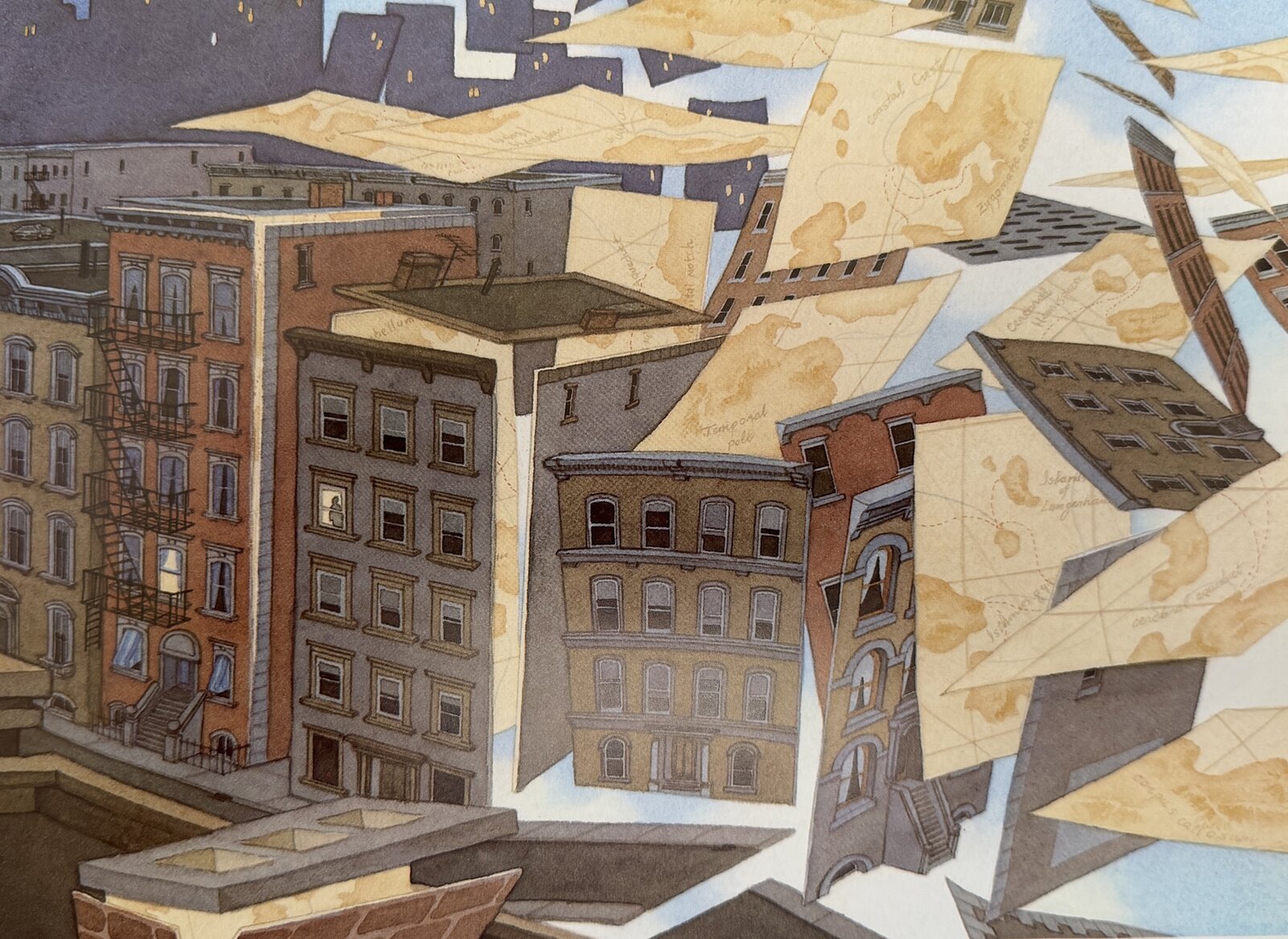 A scene from the book “Free Fall,” by the children’s book author David Wiesner
If you care to interpret the world with the greatest possible freedom and creativity, you must catch your subject at a moment when its reality is less than certain. Take that how you will.
This proposition occurred to me in a different context recently, when I took the chance to refresh my mind with a long-running website, Centauri Dreams, that always delights me with its strangeness.
According to Paul Gilster, the site’s creator and main contributor, Centauri Dreams is about “the goal of reaching the stars”–as in, actually going to them, space travel on the scale of light years. The site collects research and scientific proposals on the question, but I find it most compelling in its more speculative modes. What it would mean to us if we actually made it to other stars someday? Gilster is not a scientist or even a journalist by training. He’s a humanist, a former medieval studies scholar. I do not know what led Gilster from more conventional academic paths to this seemingly all-consuming topic. The site, now going for almost 25 years, has collected thousands of articles on its subject, and at least one book by the same name.
But I can guess that the word Dreams in Centauri Dreams is doing a lot of work for this onetime scholar of a rich but lost period in history. If there is anything that could connect the medieval world to a hypothetically ambitious future–where, to quote Gilster, human culture has “reasserted the value of the long haul” to invest in an intergenerational mission–then it would have to include a willingness to nourish the imagination to an almost unfathomable degree: from private and unsharable individual musings all way up to great art, philosophy and who knows what new cultural inventions. Yes, any conceivable version of space travel on this distance and time scale would require advanced technology. But the technology for some version of interstellar travel arguably already exists. Why is it not enough? Why don’t we do this today?
Because–why would anyone do such a thing? Why contribute to a project that might not be realized for so many generations that even your descendants would have forgotten your name?
What we might call the “interstellar mindset” is inconceivable from the present moment. But I can see how it might look a little more plausible to someone who has studied some of the high points of the human imagination from the distant past. In the meantime, what I admire about Gilster’s project is that he has carved out a niche for himself, where one person’s eccentric celestial dream can be nourished, undisturbed. As for the scientists, the practical people, the powers of this world: let them take their time to catch up. For now, Gilster’s topic remains a surprisingly hospitable zone for a creative humanist. The implausibility of the venture protects him. Where does the barest possibility exist, with few plans in the works? We need more places like this. Maybe these are the spots to found a comeback of the imagination.
I have tried to brainstorm other under-speculated caves like Gilster’s. Where else might it be possible to go someday (inward or outward) that seems too far for now? Gilster’s experiment is a case study in finding a hidden vein within the world opened up by the rational Enlightenment–and making the most of it.